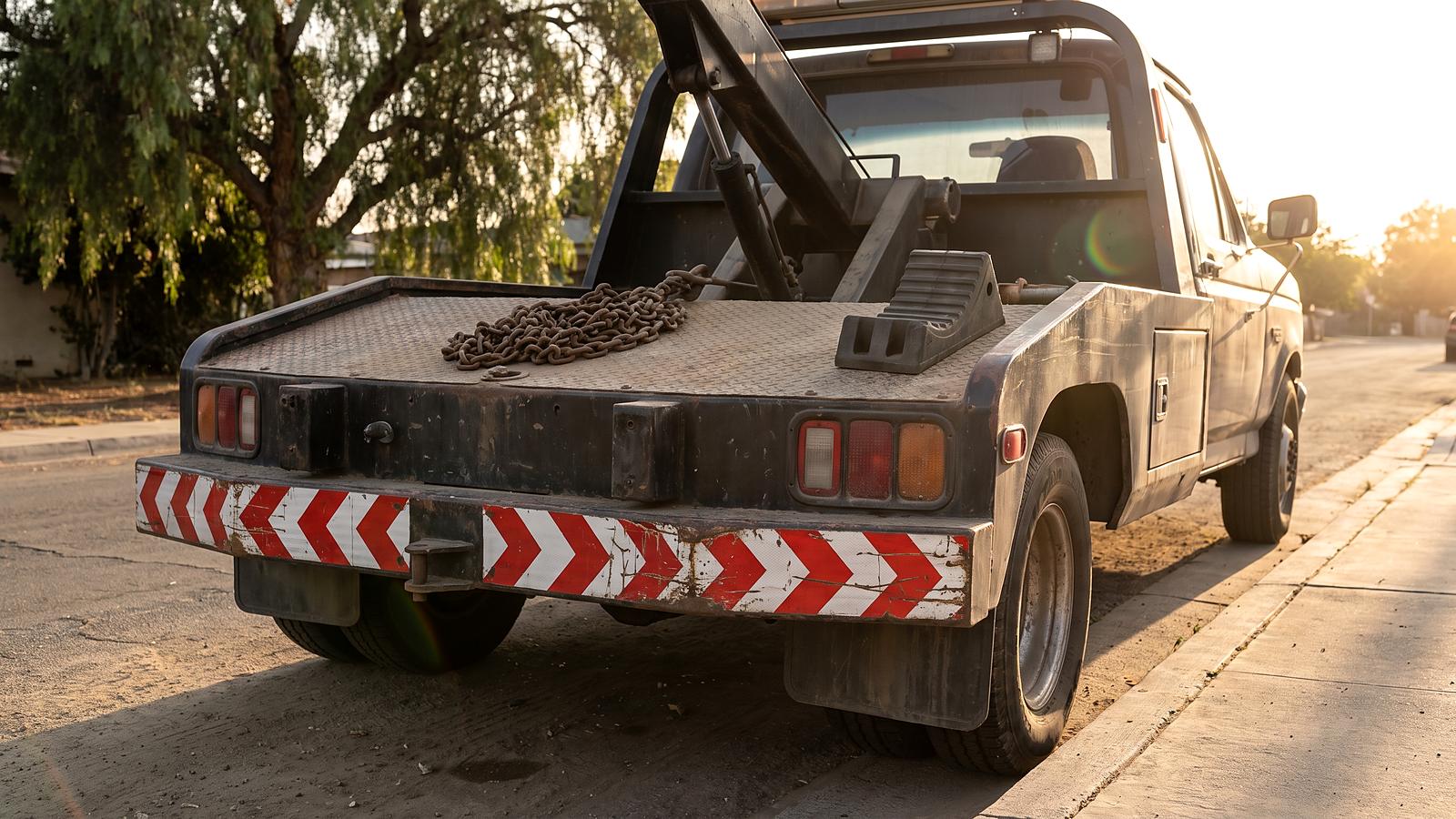
Need a tow? What towing costs in Santa Maria, CA
California has no statewide towing price, but it does regulate tows that other people order. When you're the one calling, the price comes from the job itself. Scroll down and we'll take you through every piece of it.
First, figure out who ordered the tow - it changes everything about the price
Here's the short version of towing cost in Santa Maria. Call Santa Maria Tow Truck and you hear one all-in price on the phone; your invoice matches it. California's price rules only kick in when someone else - a property owner or an officer - orders the tow. This page prices both kinds, starting with the 24/7 towing across Santa Maria and the Central Coast you book yourself.
A tow you arrange is exactly what it sounds like. Say your car won't start in the Town Center lot on Broadway: you ring us, we price the entire job, and a truck heads your way only after you say yes.
A tow someone else orders works differently. A property owner can have a car hauled off a private lot, or an officer can have it removed for blocking traffic following a collision, sitting on the freeway right of way for over four hours, having at least five parking tickets left unpaid, or parking in one spot for at least 72 hours straight, against Santa Maria Municipal Code 7-5.22. The car's owner gets the bill without ever choosing the tow company.
Don't bother hunting for a state towing price list - California has none. It has two statutes instead: CVC 22658 measures a private-property tow against a benchmark rate, and CVC 22651.07 dictates what a tow yard's invoice must say. The CHP signs off on its own rotation rates separately in every Area and doesn't release them. When you're the one booking, none of that sets your price: we agree on it over the phone, and it shouldn't change once the truck arrives.
Free quote
Towed from a private lot? Know these California rules
If your car is hauled off a private lot in Santa Maria, CVC 22658 is the law that governs it. It doesn't name a price. Instead, it lists what the lot has to do before the car can be moved, caps parts of the bill that follows, and sets one benchmark rate. A lot that ignores the sign and notice requirements owes the owner double what it charged for towing and storage.
What must happen before the car moves
- Posted signs at each entrance, no smaller than 17 by 22 inches with letters an inch tall, listing every towing company and the police phone number - or else a parking-violation notice left on the car for 96 hours.
- Written permission from the property owner or lessee, who must be there at the time, naming the car's make, model, VIN and plate; an advance, standing authorization only covers a car parked less than 15 feet from a hydrant, in a fire lane or across an entrance, and the car must be photographed first.
- An hour's grace. CVC 22953 bars towing from a no-charge lot the public may use until a car has been there an hour - except when it blocks a hydrant, a fire lane or an entrance, or sits in a disabled space.
- A call to police within an hour of approving the tow.
Limits on what you can be charged
- You arrive before it leaves
- Get to the car before it's driven off the lot and ask for it: the tow driver has to release it to you on the spot, no strings attached
- Hooked but not gone
- If the car is already attached to the truck but hasn't left the lot, you owe no more than half of the normal towing charge
- How far the yard can be
- Storage can only be billed if the yard sits within 10 miles of the lot, unless law enforcement gave written approval for a yard farther away
- Picked up within a day
- Collect the car within 24 hours of its arrival at the yard and you're billed a single day of storage, even when midnight falls in between
- Pickup after closing
- The yard has to release cars outside business hours, and its hourly gate fee can't exceed half the hourly towing rate
- Paying the yard
- The yard must take cash or a bank-issued credit card
- The price ceiling
- Any charge above what the same tow or storage would have cost if law enforcement had requested it, under its agreement with the yard, is excessive
That last rule explains why no one can publish a legal private-property towing rate for Santa Maria: the benchmark is a CHP-approved rotation rate that stays unpublished.
Know your rights at the yard
No matter who ordered the tow, CVC 22651.07 makes the yard display a standard notice of your rights in its office, print that notice on every itemized invoice, and give you the invoice before you pay. The notice says you can collect your belongings from the car free of charge on weekdays from 8 a.m. to 5 p.m., and that you can pay with cash, a check from your insurer or a bank-issued credit card.
If Santa Maria police ordered the tow, the release is handled by SMPD Records at (805) 928-3781 ext. 2294, weekdays from 8 a.m. to 5 p.m. The registered owner brings a license and current registration and pays a City administrative release fee as well as the yard's towing and storage charges. When the CHP stored a car, the tow company releases it; when the CHP impounded it, you'll need a CHP release first - call (805) 608-6310.
Here's what goes into the price when you call us
When you book the tow yourself, the job sets the price. Here's each piece we weigh, in the order we ask about it on the call.
How far, and which way
Distance comes first. A hop from the Crossroads over to a Stowell Road shop barely registers, while a dealer in San Luis Obispo means about 30 miles up the 101. Direction counts as well: east of town on the 166 the next services are 52 miles out, so the truck's miles there and back set the price.
Does the hour matter?
Only for timing. The hour changes how soon we can reach you - we'll give you that on the phone - but never the math, so a middle-of-the-night emergency tow off the 101 shoulder at 3 a.m. is worked out exactly like a Tuesday-afternoon tow from a driveway off Miller Street.
Pick the truck by the car
Our lowest-cost truck, the wheel-lift, can carry a front-wheel-drive sedan with its driven wheels off the ground. Plenty of others can't, and the manufacturers say so in writing: Subaru's manual forbids moving its AWD models with one axle still rolling, Tesla asks that a Model 3 ride a flatbed because its motors make electricity any time the wheels turn, and AAA rates the wheel-lift unsuitable for low-riding cars and for motorcycles. Each of those goes on our flatbed, the same truck we use for longer transports, and your quote is built around it.
- Pulling it free first. A car on four good tires is aboard in a few minutes. A pickup sunk to its axles in sand, or a car nosed into a ditch beside a farm road, needs pulling out onto solid footing before it loads - a winch-out job with cable, snatch block and strap that we price on its own.
- The small stuff. A toll on the route; standing time while the CHP releases a crashed car, while someone brings a key or while a farm gate opens; a car with no key and a locked steering wheel. Each one is in your quote, not sprung on you with the invoice.
Hold off on saying yes until the quote covers these points
A quote with gaps in it will cost you later, so run it past this checklist.
Ask for the whole job's price
Push for one price covering the entire job. A per-hour rate won't do, and neither will a figure with 'starting' in front of it. Nobody can give you a real total without first asking about your location, your vehicle and the destination - so a company that skips those questions can't honor its number when the truck pulls up. One more check: whoever picked up the phone, whoever's name is on the side of the truck and whoever bills you should be one and the same company. If they aren't, ask which company is really on its way.
The items it should list
- What loading costs - the basic charge to hook up your car and get it rolling
- How the miles add up - how many come included, and what each one past that costs
- Any pulling out - if the car needs winching first, that's a separate charge
- If it's stored - the daily charge, the hours you can collect the car and any fee for an after-hours release
- Odds and ends - tolls, waiting time or setting up dollies, named now instead of turning up on the bill
Do you even need a tow?
Ask yourself first. A battery that died on a chilly morning, a flat tire when the trunk holds a good spare, an empty tank on the way to Guadalupe, keys locked in the car at the airport - battery, tire, fuel and lockout help at your car is its own job, and it usually costs you less than towing would.
Hold the yard's invoice to this list
Whoever ordered the tow, CVC 22651.07 says the invoice you get before paying must show the tow company's business ID and carrier number; your vehicle's year, make, model, VIN and plate; the dispatch, arrival and finish times; each fee on its own line; the daily storage rate and how many days the car was held; any gate fee; how the car was towed; and who asked for the tow. Hold those three times up against any waiting charge.
How far your town is - and how that affects the price
Start from central Santa Maria and count: Orcutt is about 6 miles, Nipomo 7, Guadalupe 9, Arroyo Grande 16, Vandenberg Space Force Base and Grover Beach 18, Los Alamos 19, Pismo Beach 22, Lompoc 25, San Luis Obispo 30, Buellton 33, Solvang 36, New Cuyama 54 out the 166 and Santa Barbara 63 down the 101. Anywhere on that list stays within our usual range; farther out, the whole distance the truck travels goes into the price.
Why there's no free highway help here
US 101 through Santa Maria, Orcutt, Nipomo and Los Alamos has no Freeway Service Patrol: Santa Barbara County's patrol stays on the South Coast, and San Luis Obispo County's ends at Pismo Beach. That leaves the CHP and private tow companies. Once a car has been on the freeway right of way for four hours, an officer can have it removed, so make your call well before that.
Frequently asked questions
I'm in California and need a tow - how is the price set?
California doesn't publish a towing price, so when you book with Santa Maria Tow Truck we add up your job - how far it goes, where it ends, which truck suits your car and any time spent pulling it free - and read you one total over the phone. A tow somebody else orders is different: under CVC 22658, a private-property tow charge is excessive once it tops what the same tow would have cost at local law enforcement's request.
I only need to go a few blocks - how low can the price go?
There's no legal minimum in California to point to. Your smallest possible bill from Santa Maria Tow Truck is close to the hook-up charge alone: a car on good tires, a short run, the wheel-lift. Add miles, a flatbed or recovery work and the total climbs from there. On a private lot the law protects you in the other direction: under CVC 22658, if you reach the car before it leaves the property, the driver has to release it, and once it's hooked but still on the lot, the most you can owe is half the usual towing fee.
I'm paying storage every day my car sits at the yard - is there a limit?
California doesn't set a daily storage figure, but CVC 22651.07 requires the yard's invoice to list its daily rate and how many days your car was held. After a private-property tow, CVC 22658 adds more limits: no storage fees unless the yard is within 10 miles of the lot, just one day's charge if you get the car out within 24 hours, an after-hours release fee no higher than half the hourly towing rate, and an overall ceiling tied to the rotation rate for local law enforcement. Santa Maria Tow Truck can't quote you another company's rate, but those rules tell you what to check.
My car died at 2 a.m. - is there a night rate?
There's no night rate at Santa Maria Tow Truck. We price the job itself - the miles, the truck your car calls for, any recovery and any waiting - and you hear the total before a truck leaves, whatever the day or hour. What 2 a.m. can change is how long we take to reach you, and we'll tell you that on the phone.
I'm on a tight budget - what's the cheapest way to handle a breakdown?
Start by asking whether you need a tow at all - a boost or a spare swapped on costs less, and your roadside plan might cover it. When a tow is the answer, a short wheel-lift run is the least Santa Maria Tow Truck charges, and the full price comes before we leave. And call early: no free Freeway Service Patrol works the 101 through Santa Maria, and after four hours on the freeway right of way, an officer can order the car removed.
Want a firm number? Give us these four details
Share them and you'll have a complete price to weigh while you decide.
- Start and finish - the 101 exit or cross street where you are, and which shop should get the car
- Your ride - make, model and year, and whether it's AWD, electric or a motorcycle
- The problem - won't start, crashed, stuck, flat tire, empty tank or keys locked inside
- Card or cash - tell us which, so paying is simple when the truck pulls up