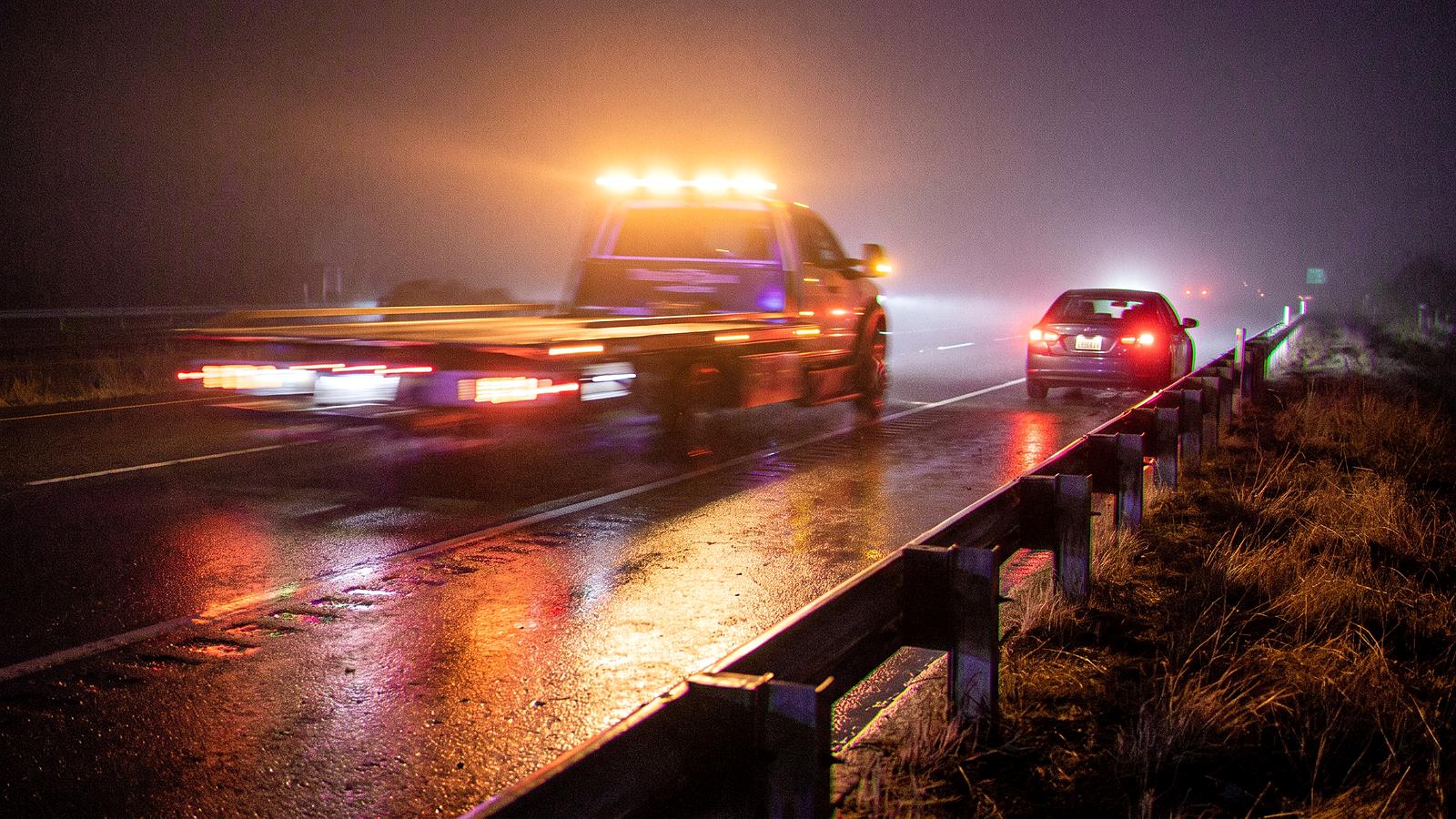
Need a tow? Emergency towing in Santa Maria, CA
Car quit on the 101 in the middle of the night? Call Santa Maria Tow Truck. We send a light-duty tow truck anywhere from Orcutt to Nipomo and tell you our timing while you're still on the phone.
Stuck at 2 a.m.? Here's what to do, one step at a time
Step one is simply calling us. The hour doesn't change a thing about how that call runs: we get your location, your car and the problem from you, and a truck is assigned before we say goodbye. Everything on this page is for problems that won't hold till sunrise; routine jobs live on our main page for towing in Santa Maria.
Step two is pinning down your spot. On a freeway, that's the road, north or south, and the exit number you just went by - '101 north, just past Betteravia, exit 169,' for example. Around town, just give us the nearest intersection. Get this right and our driver won't end up across the median from you.
Our questions, one at a time
- Your whereabouts - which freeway and in which direction, plus the exit number; in town, a street name and the closest intersection.
- Your ride - make, model and year, and whether it's all-wheel drive, electric or a motorcycle.
- The problem - it won't start, it quit on you, it's been in a crash, it has a flat, or it's stuck in sand.
- Its next stop - a body shop, your own mechanic, the dealer or your driveway.
Step three is ours: we match a truck to your answers, then give you the total and a time window before we hang up. Nobody can promise you an exact number of minutes on a foggy highway, so expect a heads-up call from the driver as the truck gets near you. One more thing to know: there's no Freeway Service Patrol on US 101 through Santa Maria, Orcutt, Nipomo or Los Alamos, so if you're stranded here, the CHP and a private tow company are your only help.
Get your total up front: what shapes the price of a night tow
Whatever the hour, you hear the whole price on the phone, and nothing moves until you say yes. Four things matter most here; for the full list, see every factor behind an emergency towing quote.
- Miles driven - the drive out to your car counts, and so does the loaded run to wherever it's going. A Nipomo-to-Betteravia run is short; a trip out of the Cuyama canyon is not.
- Time spent loading - a car that can roll is quicker to load than a car that needs dollies, and pulling a car out of sand or mud is priced separately.
- Which truck it takes - a front-wheel-drive economy car rides the wheel-lift; for AWD, electric or lowered cars and motorcycles, we bring the flatbed.
- The last stop - one trip to a closed shop's key drop tonight, or two trips: home now, then on to the shop in the morning. Each option carries its own price.
You won't find a rate card on this site. A price that ignores the distance and the vehicle would only be a guess, and California doesn't cap towing prices in dollars statewide anyway. Two types of tow do follow rules. When the CHP orders a car cleared from the road, it's a rotation tow, billed at rates that each tow operator puts forward and the local CHP Area commander approves - and because those rates stay unpublished, nobody can tell you the figure. A tow from private property under Vehicle Code section 22658 can't cost more than that law-enforcement rate would have.
Whichever kind of tow it is, section 22651.07 gives you the right to a detailed invoice before any money changes hands: the times the truck was sent, got there and wrapped up, each fee listed separately, and who ordered the tow. We write our invoices the same way, even when the call came from you.
Here's how we load your car, step by step
The first few minutes - getting your car onto the truck - matter more than the drive itself. On the wheel-lift, the end that does the driving goes up by its tires while the other two keep rolling. On the flatbed, the deck slides back and tips to the pavement, the winch draws the car aboard, and not one wheel turns until we unload. Each of our trucks is light-duty, so something like a loaded produce truck stranded on the 166 is beyond them, and you'll hear that before we send anything.
First, we check what drives your wheels
If your sedan drives through its front wheels and came through without damage, the wheel-lift will carry it. All-wheel and four-wheel drive are another story: with one axle up and the other turning on the road, the gearing that links them - a center differential or a transfer case - gets forced against itself, so those ride the flatbed. Subaru's manual leaves no doubt - its all-wheel-drive models should never be towed with a single axle raised. Tesla's guidance for tow operators forbids letting a Model 3's tires spin, which puts electric cars on the deck as well. Motorcycles, low-slung cars and anything with a wheel or frame bent in a crash go there too - the flatbed tow for a car that won't roll.
Strapping it down
Here's the order on the deck. First, a strap goes over each tire and gets ratcheted snug, so the tires hold the weight and the body takes none. Second, where a tire strap can't go, the driver uses a soft strap on a load-rated anchor point or hooks the tow slots built into the frame - never anything wrapped around steering or suspension parts. Third, a motorcycle goes upright into a wheel chock, tied at the frame and never left on its center stand. And have your key ready: the driver needs it to shift out of park, release the brake and free the steering before loading.
Grab your things first
Before we load, take out whatever you'll need tonight: wallet, phone, any medicine. An impound is a different animal. It's ordered by an officer or the owner of a private lot, the car ends up at a storage yard billing by the day, and you may collect your belongings there at no charge on weekdays from 8 a.m. to 5 p.m. Came back and the car was gone? Off a city street, start with SMPD's non-emergency number, (805) 928-3781 ext. 2277; off the freeway, try the CHP Santa Maria Area office at (805) 608-6310.
Get off the road and stay off it: waiting safely on the 101 and the 166
1. Get the car all the way out of the lane and onto the shoulder, then switch on your hazard lights. 2. Climb out through a right-hand door and walk well back from the pavement - and when a guardrail runs along that stretch, put it between you and the road. Cars beside you on the 101 are doing freeway speed, and in fog their drivers see you late. 3. Someone injured, or your car halted mid-lane? 911 handles that before we do.
When a car is partly in a traffic lane, the CHP takes charge before we can: officers can have a vehicle removed if it blocks traffic or has sat on the freeway longer than four hours, and the tow truck they call might belong to another company. As of January 1, 2026, California's Move Over law protects any stopped car with its hazards on, not just tow trucks with amber lights - but don't stand anywhere that depends on other drivers obeying it.
Fog, floods and 52 empty miles
Santa Maria's fog is marine-layer cloud pinned down by an inversion, and it can hang around for days. Almost all of the year's rain arrives between November and April, and in a hard storm the low roads go under first - in January 2023 that meant Black Road, Telephone Road and part of Highway 1 - so never drive into standing water. East of town, the 166 climbs 52 miles through the Cuyama River canyon before you reach services in New Cuyama. If you break down out there, tell us the last landmark you saw.
If you've been in a collision
You choose where the car goes as long as you're fit to decide and it isn't holding up traffic - a body shop, the dealer or home. Once the CHP or Santa Maria Police order a tow to open the roadway, the officer chooses instead. In both cases, empty the car of anything you need first.
Maybe you don't need a tow at all
Some calls at this hour never become tows. Turn the key on one of our rare freezing mornings and hear a single click? Blame the battery first - AAA says it delivers about 30 percent less at 32°F. A flat with a decent spare in the trunk just needs changing. Both are quick fixes we handle right where you've stopped. And if the car simply can't get traction, it needs pulling, not towing: a winch-out from sand or a soft shoulder uses a winch line, a snatch block and a recovery strap. At Oceano Dunes, the state park itself cautions that tides, rain and blowing sand determine who gets stuck.
We roll at night to every corner of Santa Maria and the next towns over
Day or night, we reach the entire city: the Town Center at Broadway and Main, Enos Ranch and the Crossroads by Betteravia, Hancock College, Marian Regional and the airport. We also go to Orcutt, about six miles away off exit 165 at Clark Avenue; Nipomo, about seven, over the river at exit 179; Guadalupe, about nine, out West Main on the 166; and Los Alamos, about eighteen, where the 135 ends.
After dark, three trouble spots stand out: the freeway shoulder between Clark Avenue and the river; the farm roads, where a work pickup can sink to its axles after winter rain; and the airport parking lot, where a car left for two weeks during a Las Vegas trip may refuse to start.
Heading farther - north on the 101 past San Luis Obispo, south past Buellton, or east on the 166 to New Cuyama, 54 miles and more than an hour each direction? Those are longer trips, and the distance drives the price.
Frequently asked questions
My car died on a holiday weekend - will you still come?
Santa Maria Tow Truck takes calls all day and all night, holidays included, and a holiday call at 3 a.m. gets a truck just as a Tuesday-afternoon call would. Two things help most at night: know the exit number or nearest intersection, and keep your phone charged and switched on so the driver can reach you.
You'll get a time window during the call, set by our truck's position, the fog and the traffic.
I'm broken down on the 101 - should I stay in the car, and how do I tell you where I am?
Stay inside only when the car sits in a lane of moving traffic - then keep your belt on and call 911. If you made it onto the shoulder, switch on the hazards, leave through a passenger door and put the guardrail between you and the traffic while Santa Maria Tow Truck is on the way.
Then name the exits on either side of you - 165 Clark Avenue, 166 Union Valley Parkway, 167 Santa Maria Way, 169 Betteravia, 170 Stowell, 171 Main Street, 172 Donovan, 173 Broadway, 175 for the 166 East at the river, or 179 Tefft Street in Nipomo - so our driver comes in heading the right way.
I just had a fender bender - do I get to choose where my car goes?
After a minor crash, the destination is normally your call. As long as you're in shape to decide and the wreck isn't in anyone's way, Santa Maria Tow Truck will take the car wherever you pick, whether that's a body shop, the dealership or your garage. If a CHP or Santa Maria Police officer has it towed to open the road, the officer names the destination instead.
According to CHP Santa Maria, a stored vehicle - a wrecked car that can't be driven, for instance - can be picked up from the tow company by its registered owner, while an impounded vehicle is held until the CHP releases it.
I only need a short tow across town - is there a price floor?
Santa Maria Tow Truck has no set minimum, and no California statute puts a price on towing, so there's no floor to quote you: your number depends on the miles, the time at the scene, the vehicle and any winching needed first. A short wheel-lift hop across town sits at the low end; a flatbed trip to San Luis Obispo does not.
The law only prices tows you didn't order yourself. A CHP rotation tow is billed at rates each operator files with the CHP Area commander, which aren't made public, and a private-property tow under Vehicle Code section 22658 can't cost more than that rotation rate would have.
A tow truck is hooking up my car right now - do I have to let it go?
On private property you often don't. Under Vehicle Code section 22658, ask for the car before it leaves the lot and the tow company has to release it on the spot, no conditions; if it's already hooked up but hasn't left, you pay at most half the usual towing fee.
A tow an officer ordered goes ahead regardless. Instead, ask the agency for a post-storage hearing - the request is due within 10 days of the date on the notice - and it must hold one within 48 hours of your request; if the storage wasn't justified, the agency pays. And if you're the one who called us, you can cancel anytime: the moment your engine comes back to life, phone Santa Maria Tow Truck and our truck turns around.
Stuck on the roadside tonight? Read us these four details
Give us these, and you won't be left guessing about the price or the wait.
- Your whereabouts - freeway, direction of travel and exit number, or the nearest intersection in town
- Your ride - make, model and year, and whether it's AWD, electric or a motorcycle
- The problem - won't start, crashed, flat tire, or stuck in sand or mud
- Its next stop - a body shop, your mechanic, the dealer or home