Need a tow? Roadside assistance in Santa Maria, CA - or a fix on the spot
We'll try to get you going right where you are - a jump, a tire swap, a few gallons of fuel or a door opened - and because we arrive in a tow truck, we can still carry the car if that doesn't work.
Two answers get you the right roadside assistance in Santa Maria
The quickest fix starts with a good description. Santa Maria Tow Truck handles roadside assistance in Santa Maria at any hour, and all we need from you is how the car is acting and the precise spot where it stopped. With that, we pack the truck for your job before it leaves.
Start with the symptom - what happens as you try to start it? Hear a single click and see weak dash lights? That's almost always the battery. Engine cranks hard but won't catch? Blame fuel or spark - booster power does nothing for either. Thumping from one wheel means a tire, and keys visible through the window mean a lockout.
Next, tell us where you are. In town, a street name and the nearest intersection will do. On the 101, give your direction and read us the number on the last exit sign: 165 Clark Avenue at Orcutt, 166 Union Valley Parkway, 167 Santa Maria Way, 169 Betteravia, 170 Stowell, 171 Main Street, 172 Donovan, 173 Broadway or 175 at the Santa Maria River.
Good to know before you wait: no Freeway Service Patrol truck works the 101 around here. Santa Barbara County's patrol covers only the South Coast, and San Luis Obispo County's stops at Pismo Beach, so there's no free gallon of gas coming. If you're stopped, your options are the CHP and a private company like ours with a roadside kit.
Step three happens on our end: you hear a price and a time window, and the truck rolls out packed for your problem - a booster pack for a battery, a jack and impact wrench for a tire, the right fuel for an empty tank, door-opening tools for a lockout. And if the fix doesn't take, the car simply goes up on the same truck.
Save money: let us try the fix before we hook anything up
Here's the math. A roadside visit covers our drive to you and the work at your car, and it ends with the engine running. A tow means a hook-up fee and then paying for distance, mile by mile, with your car aboard. So a jump in a driveway off Bradley Road will always cost you less than a trip to the shop on a hook.
California's towing rules target tows that someone else ordered. Vehicle Code 22658 sets the terms for a private-lot tow: a fee capped at half if you reach the car once it's hooked, one day of storage if you collect it within 24 hours, and nothing above the rate approved for local police rotation tows. None of that touches a jump start you ask for, so the number we settle on when you call is what you pay. For more, see how a roadside visit is priced next to a tow.
The price of a visit depends on four factors:
- Your spot on the map. Jumping a car on Main Street is a quick trip; a flat on Highway 1 toward Guadalupe or a fuel delivery out the 166 adds driving time in both directions.
- Gallons poured. Whatever gas or diesel goes into your tank is billed as its own line.
- How long it takes. Jumps are over fast; a rusted lug nut or keys locked in the trunk can stretch the visit, and you'll hear about that before you agree.
- Whether the fix holds. Should the car die again right after the fix, we switch to a tow - priced first, and loaded only after you say yes.
Here's exactly how we handle a jump, a flat, an empty tank or a lockout
Jump-starting a dead battery
Dead batteries are our most frequent roadside call in Santa Maria, and around here the cause is usually a car that sat, not the weather. Think of a car left for a week at the airport lot on Terminal Drive, or one that only ever makes short hops between Orcutt and the Town Center. An aging battery, a few idle days, and one morning all you hear is a click.
Cold weather can finish the job. AAA says a battery delivers about 30 percent less at 32°F, and while Santa Maria's December mean low of 40.1°F means frost is occasional, a battery that has been limping along since summer tends to pick one of those mornings to give up.
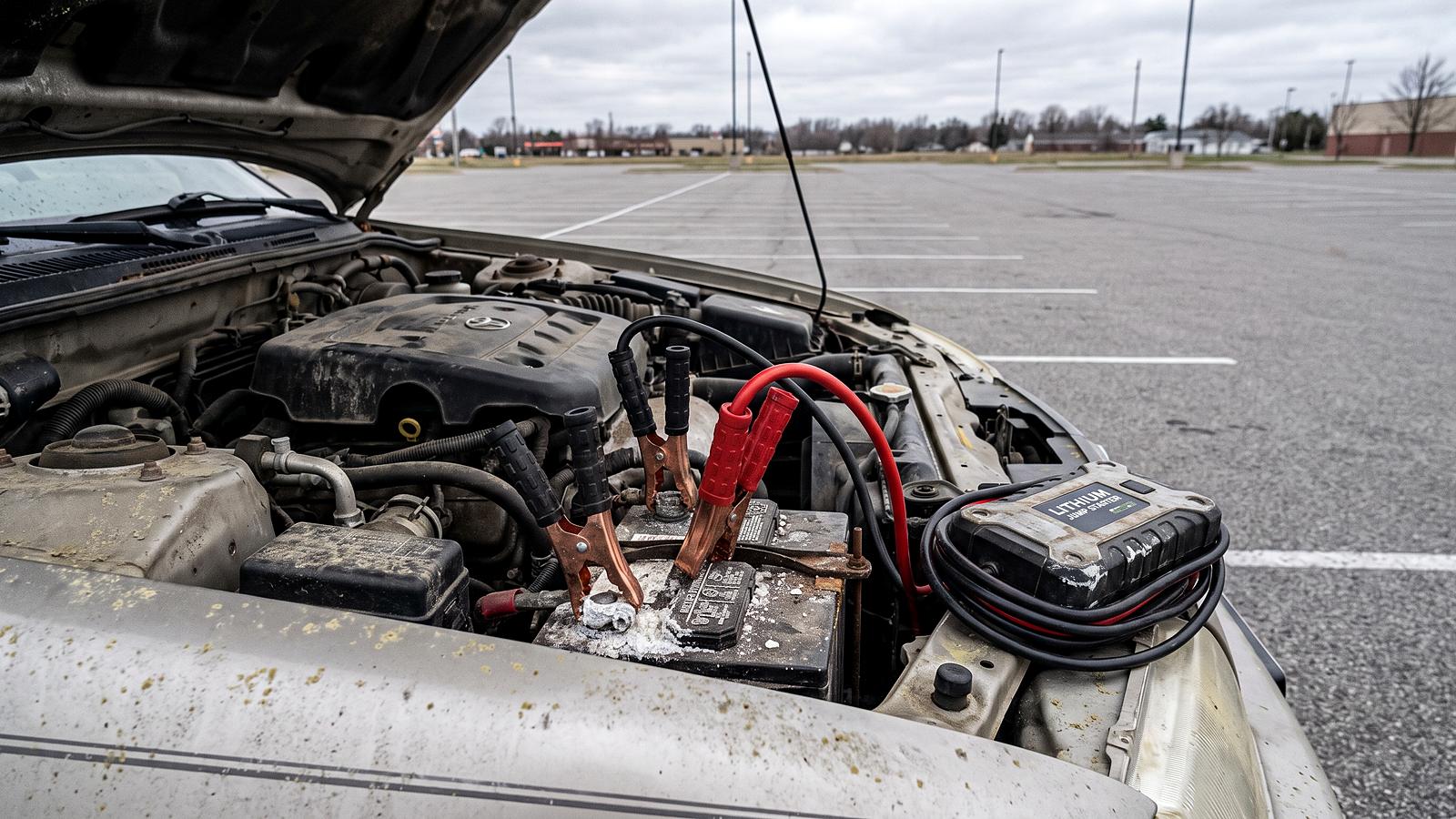
Here's how the jump goes. First the booster pack goes on and the engine starts. Next we read the alternator's output with a meter, because a tired battery and a dead alternator look identical at first. Then it's your turn: drive somewhere real rather than circling the block. Should the car die a second time, or the charging warning refuse to go out, we tow it instead.
Swapping a flat tire
If there's a usable spare in the car, it's five steps: up goes the car on the jack, off comes the flat, on goes the spare, the lugs get torqued to spec, and we check the spare's air - one that has sat under the cargo floor for years often comes up short on pressure. A temporary spare is built for limited miles at lower speeds, so make a Santa Maria tire shop your next stop, before any long run up the 101 toward San Luis Obispo.
No spare? You're not alone - lots of newer cars skip it. Run-flat tires will carry you a short distance at low speed, so a glowing tire-pressure light might be the only warning you get. A sealant-and-inflator kit can seal a small puncture in the tread, never a gashed sidewall. And if there's no spare and the tire won't hold air, we load the car and take it to a tire shop.
Locking lug nuts only come off with their matching key, and we can't make one on the spot, so hunt for it now - check the jack pouch first, then the glove box. If you're on a dirt farm road or a soft shoulder, mention it - a jack needs solid, level ground under it.
Bringing you fuel
Out the 166 east of the freeway is where we deliver fuel most, since the sign at the 101 warns that the next services are 52 miles off in New Cuyama. First we'll confirm gas or diesel, because the wrong fuel turns a quick stop into a job for a mechanic. Then we bring a can with enough in it to get you to a pump.
One tip while you wait: try not to make running dry a habit. The pump lives inside the tank, bathed in fuel that keeps its temperature down, so an empty tank makes it work hot - one time rarely hurts, but repeat offenses can. Once the fuel is in, expect the engine to crank a little longer than usual while the lines fill back up; we stay put until it idles on its own.
Opening a locked car
Keys on the seat? Fob quit in the Costco lot on Bradley Road? Here's what we do. First, a small inflatable wedge goes into the top of the door frame to open a gap. Then a thin rod reaches in and presses the lock button, and the paint, rubber seal and lock come through without a mark. Some cars need a pick instead, which is why we ask the make, model and year. Bring your driver's license, and once you're back in, show us the registration.
Phone 911 now. After the morning fog burns off, the air inside a closed-up car turns dangerous fast, and a broken window is a fair trade for that - so never sit tight waiting for our truck.
Skip the roadside fix and ask for a tow when you see these signs
Certain problems need towing no matter what, so if you notice any of these, tell us and we'll send the tow truck first:
- The engine stumbles and a light comes on. A blinking check-engine light or a lit oil-pressure warning means stop driving it right there.
- Steam or a maxed-out gauge. Either one tells you the cooling system is done, and our roadside tools can't repair that.
- The jump doesn't last. If the car quits again minutes after we start it, the alternator has likely failed, and a second jump won't get you any farther.
- A bent or broken wheel. A cracked rim, or a tire torn apart at highway speed, is beyond what a spare can solve.
- Stuck in park. When the parking pawl won't let go, we have to lift the driven wheels onto the truck.
- Buried in sand or mud. Sunk to the axles on the beach at Oceano or on a farm road, the car needs a winch before anything else.
Spot any of those and we'll skip the kit and send a tow truck right away instead of a roadside visit. An all-wheel-drive car, an EV or anything that rides low then heads to the shop on a flatbed ride with all tires lifted clear, because Subaru and Tesla both insist: Subaru warns that its all-wheel-drive models must never be pulled with just the front or just the rear raised, and Tesla wants a Model 3 carried so its tires never turn.
Watch the clock, too. Under Vehicle Code 22651, an officer can have a car removed once it has been left along the freeway for over four hours, and Santa Maria's municipal code allows 72 straight hours parked in the same place on a city street. A car that won't start gets no extra time, so call before either limit arrives.
And it works both ways. When all you hear is one click on a chilly morning, when a tire sagged overnight, when the fob is sitting on the console at the Town Center, you don't need a flatbed - and we won't send one.
Wherever you're stuck in the valley, the roadside kit comes to you
Wherever Santa Maria Tow Truck's towing service reaches, a roadside visit can too: the 101 from Clark Avenue up to the river, Broadway and Main through the Town Center, and Betteravia out to Black Road. Distances run about 6 miles to Orcutt, 7 to Nipomo at Tefft Street, 9 to Guadalupe via West Main and Highway 1, about 18 to Los Alamos or Vandenberg's main gate, 25 to Lompoc and roughly 30 to San Luis Obispo.
Some parking lots show up in our call log week after week, because cars sit idle there all day: the airport lot on Terminal Drive, Allan Hancock College, Marian Regional Medical Center, and the rows of spaces at the Town Center, the Crossroads and Enos Ranch.
Around here, fog is a bigger factor than frost. The marine layer leaves road shoulders damp, so when we pull up behind you on the 101 our amber lights go on, and the Move Over law says the cars behind must change lanes or drop their speed. From January 1, 2026, that law shields any stopped car showing hazard lights too, so turn yours on. Rain falls from November to April, a little under 14 inches in a typical year, and big storms swamp the low roads: in January 2023, Black Road, Telephone Road and Highway 1 between Division Street and Oso Flaco Road all flooded.
Frequently asked questions
My engine only clicks - what does that tell you?
A lone click usually tells us the battery is too weak to turn the starter, and Santa Maria Tow Truck can have you running again with a booster pack. Silence works the same way. Cranking that goes on and on with no start is another matter - that's fuel or ignition trouble, and more battery power won't solve it. And if the pack gets the engine going but it dies a few minutes later, the car needs a tow.
It hardly freezes here - so what keeps killing my battery?
Age and idle days do most of the damage in Santa Maria, not the weather. September, our warmest month, averages a 75°F high, and December's mean low is 40.1°F. Summer heat slowly weakens a battery, and cold weather reveals it: AAA says a battery delivers about 30 percent less at 32°F. Out the 166 in New Cuyama the extremes are sharper, with a January mean low of 33.2°F and an average July high of 94.6°F.
My tire's flat and there's no spare in the trunk - how do I get rolling?
Without a spare, the fix is a short tow: Santa Maria Tow Truck loads the car and takes it to a tire shop, since we can't mount a tire you don't have. A run-flat may still creep a short distance, and a sealant kit may close a small puncture in the tread, but a cut sidewall defeats both. Let us know about the spare when you call.
I ran out of gas - can you bring me some?
Santa Maria Tow Truck brings a can of gas or diesel with enough in it to get you to a pump, and the fuel is billed as its own line, separate from the visit. California's price rules, like the half-fee rule and the benchmark tied to police tow rates, apply to private-property tows, not to a delivery you request, so the phone quote is final. The price depends mainly on how far out you are and which fuel your car needs.
I locked my keys in the car - can you get me back in?
Santa Maria Tow Truck gets people back into locked cars and trunks with tools chosen for each model, so expect us to ask the make, model and year when you call. Have your license ready, and show us the registration once we've got you in. Kids or pets stuck inside? Phone 911 immediately rather than waiting on us.
Four details tell us whether to bring the jump pack or the tow truck
You'll hear what the visit costs before a truck starts toward you.
- What the engine does - a click, cranking with no start, dead silence, or a dash warning light
- Where you're parked - street and intersection, which parking lot and which row, or freeway and exit number
- Your ride and its fuel - make, model and year, plus gas or diesel
- Your spare situation - is there one in the trunk, and do you know where the wheel-lock key is?