Winch-out and recovery in Santa Maria: what happens when you call
Santa Maria Tow Truck winches pickups out of soft sand, cars out of mud and ditches, and vehicles out of flood water and crash scenes, around the clock, in Santa Maria and the towns around it. A recovery is its own kind of job, and the call starts with working out which kind.
If anyone is hurt, or the vehicle sits where traffic cannot see it in time, call 911 first; police can close a lane and we cannot. Then we need four answers.
- What it is sitting in. Sand, mud, a soft shoulder, a ditch and standing water each grip a vehicle differently and change how we rig the pull.
- How far it is from the pavement. One wheel over the asphalt edge is a short pull; thirty yards down a field road means line run out and time.
- Whether it is on its wheels. A vehicle on its side or roof is set back on its tires first, with different rigging.
- Where you are, exactly. Cross streets, the lot or ranch gate, or the highway, direction and exit number.
We quote the whole job and give you the arrival window on the call; if the vehicle will need an emergency tow after the recovery because it will not start or steer, we say so up front.
What a recovery costs in Santa Maria, and why it is quoted differently
A straight tow has a known shape: hook up, load, drive, unload. A recovery does not; nobody knows how a vehicle will come out until the line takes the load. The cost page explains why recovery is quoted differently from a straight tow; the short version is four things.
- Time on scene. Digging, resetting the anchor and pulling in stages take time, and time is the biggest variable in a recovery.
- Rigging. One line to a factory tow point is the simplest pull; a pickup buried to the axle may need a snatch block and soft straps so nothing bends.
- Distance from firm ground. The line only reaches so far, and on a field road or a beach the truck needs ground that will hold it.
- Whether a tow follows. Many vehicles drive away from a recovery; the ones that cannot go on a flatbed, a separate line on the same quote.
California sets no statewide dollar cap on a recovery you call for yourself, and the CHP rotation rates for officer-ordered tows are approved per Area and not published, so we print no figures. We give you a total on the call, not an open-ended hourly rate, and itemize the invoice the way CVC 22651.07 requires: dispatch, arrival and completion times, each charge on its own line, and who directed the tow.
What a winch-out involves: sand, mud, ditches, water and crashes
Soft sand near the dunes
The Guadalupe-Nipomo Dunes cover about 20,000 acres west of town, and at Oceano Dunes, the state park up the coast, street vehicles drive on the beach itself. The park's advice is blunt: high tides, heavy rains and blowing sand decide whether you can drive down the beach without getting stuck. A spinning wheel does not climb out of sand; it digs the truck down until the frame rests on the beach.
We clear the sand from in front of each tire and under the axle, set the strap on the factory recovery points or the frame - never a bumper or a tie-down loop - and pull slow and steady, straight back along the vehicle's own tracks. A snatch on a tow hook in sand can rip it out of the frame.
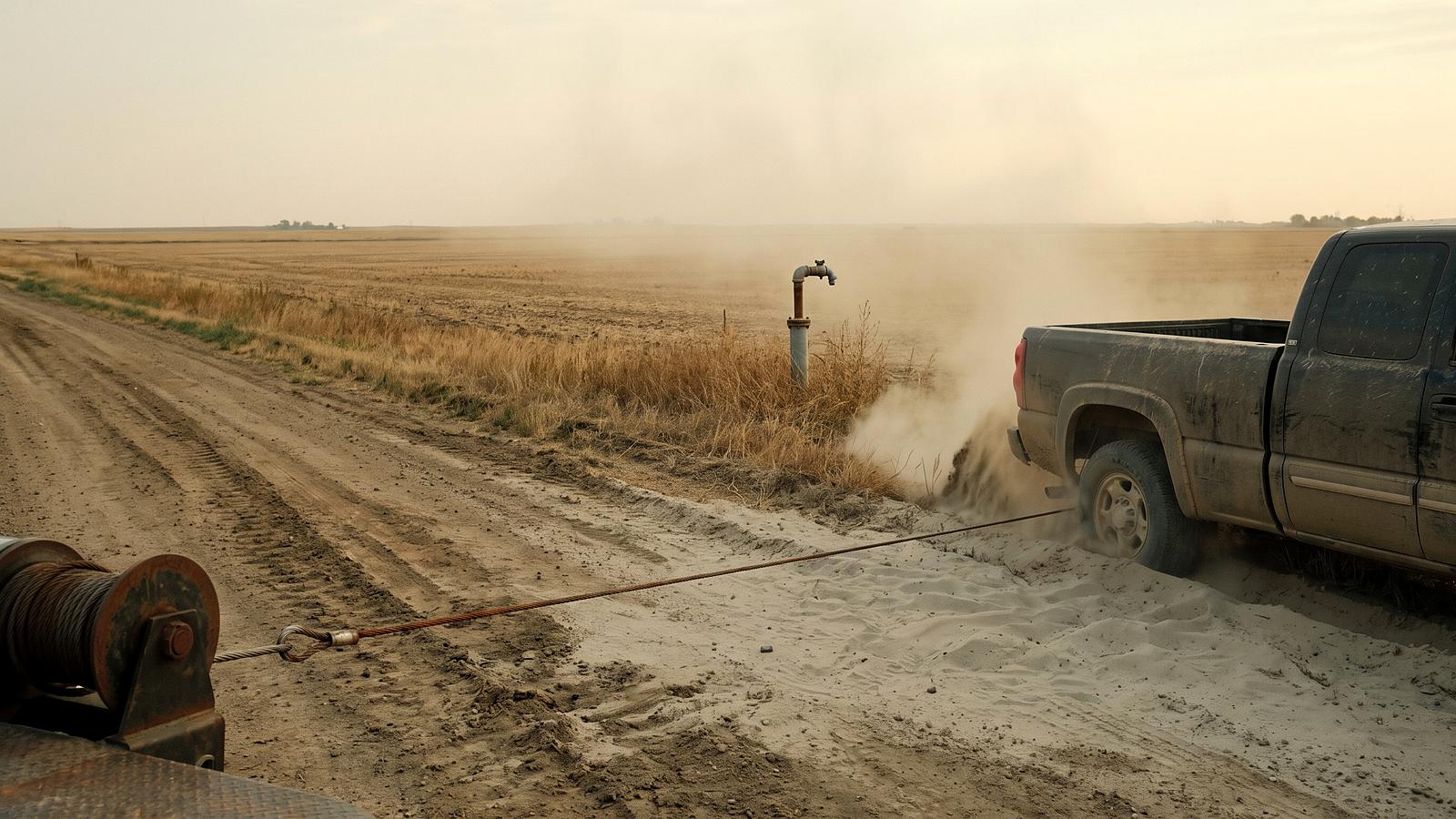
If a strap or hook lets go under load, it comes back along the line faster than anyone can step aside. Nobody stands in line with the cable while we pull. Wait well off to the side, with your passengers and helpers, until the line is slack.
Field roads and mud
Agriculture is Santa Barbara County's leading industry - strawberries have been the top crop for 22 straight years - and much of that work moves on dirt roads between the fields. Nearly all of the valley's 13.95 inches of rain falls from November to April, and the road that carried a loaded pickup in October is grease over a hard base in February, with the wheels dug in to the differential.
Mud holds by suction as well as depth, so the pull is slower. Where we can reach the stuck end we lift it with the wheel-lift so the floor pan is not dragged, and the truck stays on the packed road with the line run out: a tow truck that follows a pickup into the mud is two stuck vehicles.
Soft shoulders and ditches
After a week of rain a shoulder looks solid until a wheel drops through it. Two wheels on the shoulder is a short pull; a car nose-down in the ditch needs the front lifted so the bumper is not plowed into the bank. Straps go to the wheels or the tow points, never an axle, a tie rod or a control arm, and the pull stops the moment anything bends.
Water and flooded roads
The Santa Maria River is the county line, nearly dry most of the year until a winter storm swells it. In January 2023 Black Road closed between Main Street and Betteravia, Highway 1 flooded between Division Street and Oso Flaco Road, and a swift-water rescue was under way near the 166 and the 101; in February 2024 Highway 1 closed again from Black Road to Solomon Road.
A CHP officer said it plainly in the 2023 storm: if you see standing water, do not go through it, because you do not know what is under there or how deep it is. We winch a car out once the water has dropped enough to reach it on ground that will hold; we do not drive into moving water.
After a crash
After a crash, sequence matters: a vehicle on its side or roof is rolled back onto its wheels first, then dragged clear of the lane, and only then does the tow begin. A car that has hit something hard often cannot roll - a folded wheel, a bent knuckle - so loading a damaged vehicle on a flatbed is a winch job, up the deck on the line.
Under CVC 22651 an officer can have a vehicle removed when it obstructs traffic or creates a hazard. CHP's Santa Maria office says a collision vehicle that cannot be driven is a stored vehicle, which the registered owner collects directly from the tow company; an impounded one needs a CHP release first.
What not to do while you wait, and when a winch-out is the wrong call
The costliest part of a recovery is often what happened before anyone called.
- Do not keep spinning. One gentle try in your own tracks can free a car that is barely stuck. Once the wheels turn without the car moving, stop: in sand every spin buries the tire deeper, and in mud it polishes the rut until the tire floats.
- Do not let a friend yank it out with a strap on a trailer ball. A ball hitch is made for a trailer's steady pull, not a shock load; when it snaps it flies, and a strap on a bumper or a control arm wrecks the car the same way.
- Do not wait in a car on the freeway shoulder. On the 101 or the 166, get out on the side away from traffic. The Move Over law, CVC 21809, tells drivers to move over or slow down for a stopped tow truck with amber lights on - since January 1, 2026, for any stopped vehicle with hazards on - but not every driver does, and no Freeway Service Patrol runs on the 101 through Santa Maria, Orcutt, Nipomo or Los Alamos.
Sometimes the winch is only half the job. Subaru says never to tow an AWD model with one axle on the ground, because the center differential can make it spin away, and Tesla says a Model 3 moves only with all four tires off the ground. Those come out on a straight pull and ride home on a flatbed, as does anything with a folded wheel, bent steering or water above the floor.
A farm pickup is within a light-duty truck's rating; a tractor, a harvester or a loaded produce truck usually is not, and we say so on the phone.
Recovery across Santa Maria, Orcutt, Guadalupe, Nipomo and the valley
We run recoveries across Santa Maria, ZIP codes 93454 to 93458, from the Town Center at Broadway and Main to Enos Ranch and the Crossroads at Betteravia, and along the highways: the 101 from exit 165 at Clark Avenue in Orcutt to exit 175 at the river; Main Street east on the 166 toward the Cuyama canyon; Broadway south on the 135 through Orcutt to Los Alamos; and Highway 1 to Guadalupe and toward Vandenberg.
On a field road or a beach, give us the gate, the ranch name or the beach entrance, and share a pin if you can.
The same trucks that run Santa Maria's towing and recovery service cover the neighboring towns: Orcutt about 6 miles, Nipomo 7, Guadalupe 9, Arroyo Grande 16, Vandenberg and Grover Beach 18, Los Alamos 19, Pismo Beach 22, Lompoc 25 and San Luis Obispo about 30 by road; farther out just means a longer drive to you.
Frequently asked
What is a winch-out?
A winch-out is a recovery in which Santa Maria Tow Truck pulls a vehicle out of sand, mud, a ditch or water with the truck's winch line instead of hooking it up and driving away. The truck stays on firm ground, the cable runs to a proper anchor point, and a slow, controlled pull brings the vehicle back to the pavement.
My pickup is stuck in soft sand near the dunes - can Santa Maria Tow Truck pull it out without damage?
Usually, yes - Santa Maria Tow Truck digs the sand away from the tires and axle first, sets the strap on the factory recovery points or the frame, and pulls slowly along the pickup's own tracks so nothing takes a shock load. What we cannot undo is damage done before the call: a truck spun down onto its frame, or a bumper someone already yanked with a strap.
Do you recover vehicles after an accident?
Yes - Santa Maria Tow Truck handles accident recovery around the clock: setting a vehicle back on its wheels, dragging it clear of the lane and winching it onto a flatbed. If CHP or the police ordered the tow, their rules on storage and release apply; if you called us yourself, we quote the recovery and the flatbed together up front.
What is the 80/20 rule in towing?
The 80/20 rule is a rule of thumb for pulling a trailer, not a regulation: keep the load under about 80 percent of the tow vehicle's rated capacity, leaving margin for hills, crosswind and braking. A tow truck has its own tow rating, and matching it to the vehicle on the line is Santa Maria Tow Truck's job; if a job is beyond a light-duty truck, we say so on the call.
Can you pull a car out of flood water on a closed road?
Yes, once the water has dropped enough to reach the car on ground that will hold, and once the agency that closed the road lets us through. Santa Maria Tow Truck does not drive into moving water, and a road CHP or Caltrans has closed stays closed to us until they open it. The car comes out on the line and rides to a shop on a flatbed before anyone turns the key.