What happens when you call Santa Maria Tow Truck for a flatbed
Santa Maria Tow Truck sends a flatbed whenever the vehicle should not have a wheel turning on the road: all-wheel drive, electric, lowered, a classic, a motorcycle, or a car that will not roll or steer after a crash. The call is short and mostly questions, because the answers decide the truck.
We ask the year, make and model, then the drivetrain - all-wheel or four-wheel drive, electric or hybrid, lowered, or a motorcycle - then whether it rolls and steers, where it sits and where it is going. Front-wheel-drive and all-wheel-drive versions of the same model look alike from the curb, so if you are not sure, say so.
If the car is in a lane or on the shoulder of the 101, say that first - it is emergency towing after a breakdown or crash. California's Move Over law, CVC 21809, tells passing drivers to move a lane away from a stopped tow truck showing amber lights, or slow down, and since January 1, 2026 it covers any stopped vehicle with its hazards on, so put yours on the moment you stop.
We give you the arrival window on the call and the total before the truck moves, at any hour. 24-hour towing in Santa Maria means a flatbed at three in the morning just as it does at noon.
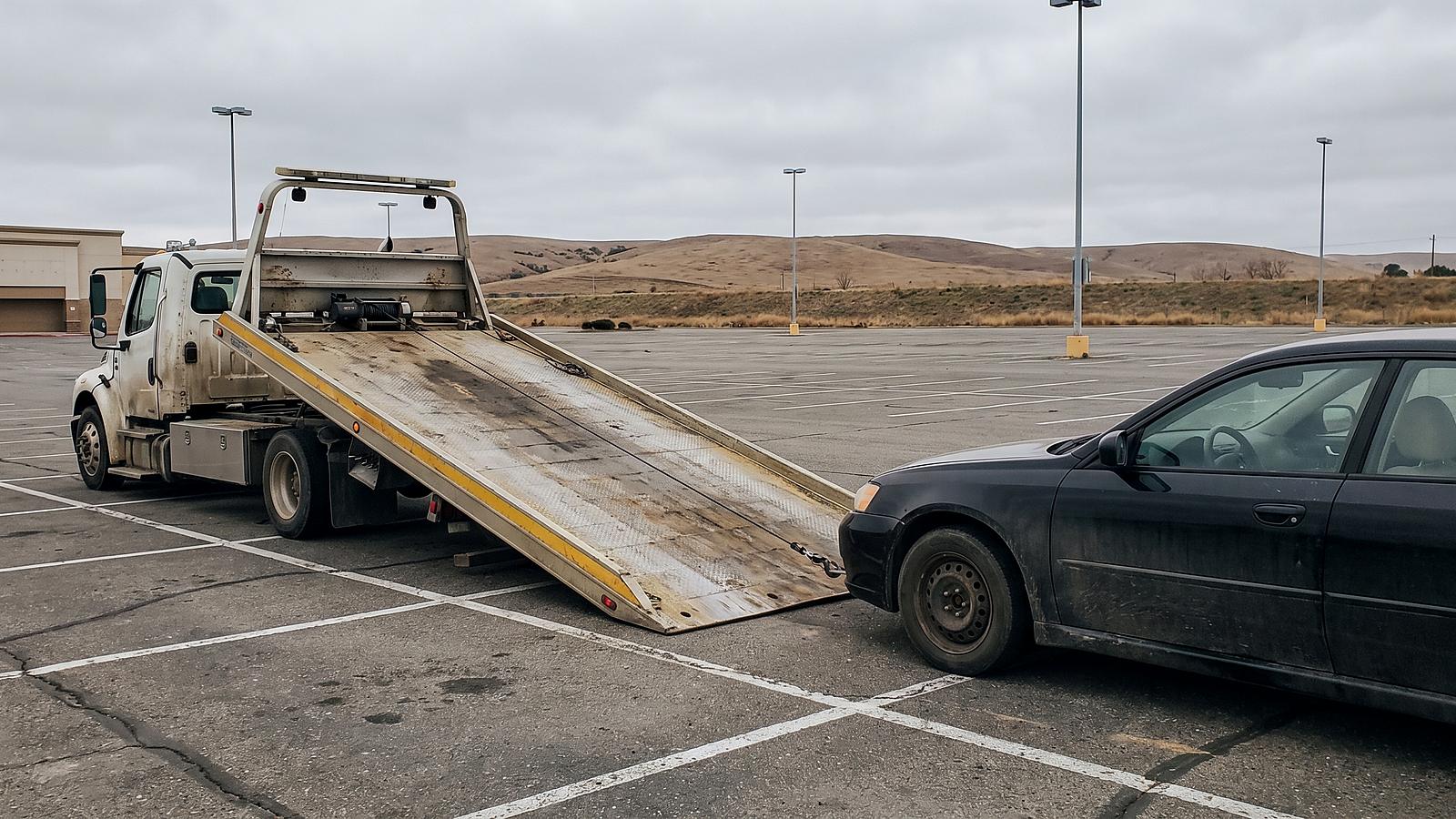
On arrival the driver photographs the vehicle, tilts the bed in line with it, runs the winch line out, hooks the tow points or fits wheel straps, and brings it up at a walking pace. Strapped at four corners, bed level, the only tires on the road are the truck's own.
What moves the price of a flatbed tow in Santa Maria
A flatbed you call for yourself is priced by us, on the phone, as one total before the truck rolls. There is no state rate card: the CHP approves rotation rates Area by Area and does not publish them, and the Vehicle Code's benchmark, in CVC 22658, is for private-property tows, where a charge is excessive if it exceeds what the law-enforcement rotation rate would have been.
Distance is the first lever. Across town - Stowell Road to a shop off Betteravia - is a local tow; Orcutt at about 6 miles or Nipomo at 7 is not much more. San Luis Obispo at about 30 miles up the 101, Lompoc at 25 or so, and Santa Barbara at 63 are priced by the mile and the hours the truck is away; New Cuyama, 54 miles out the 166 with no services between, as a round trip. Where it goes matters too - a shop that closes at five, a street with nowhere to set the deck down.
Loading time is the third lever. A car that rolls and steers winches up in one pull; one that will not - locked steering, a seized brake, a parking pawl that will not release - needs dollies under the dead end, quoted up front. A pickup dug into the sand at Oceano Dunes or a farm truck off a field road after a February storm needs recovery before the vehicle can be loaded, quoted as its own job.
The cost page goes through the mileage and distance drivers of a flatbed quote and the rules for tows the police or a property owner ordered.
Why an AWD, EV, lowered car or motorcycle rides the flatbed, not the wheel-lift
All-wheel and four-wheel drive
A wheel-lift raises one axle and lets the other roll; on an all-wheel-drive car the axles are linked through a center differential or transfer case, so the whole system turns from the road. Nissan's bulletin on its AWD automatics: "DO NOT Flat Tow - doing so will damage internal transmission components" and "DO NOT use a tow dolly - doing so will damage drivetrain components." Mitsubishi says AWD models "must be transported on a 'flatbed' tow truck" or at minimum with a dolly under the unlifted axle. Subaru's manual says never to tow an AWD model with one pair of wheels on the ground, because of the center differential. AAA calls a flatbed "ideal for all-wheel and four-wheel drive vehicles."
Electric cars and hybrids
An electric car's motor generates power whenever the wheels spin, so Tesla says to "always transport Model 3 with all four tires off the ground" and calls a flatbed "the recommended method." Without one, Tesla allows dollies, all four wheels up, for a maximum of 35 miles - and with San Luis Obispo about 30 miles from here and Santa Barbara 63, a run to either is a flatbed job by the manual's own arithmetic. The Model S manual puts it in capitals: never transport the car with the tires where they can spin, because the overheating can be significant. Tow Mode keeps the parking brake off for winching up the bed, wheels turning slowly for less than 30 feet, and damage from improper transporting is not covered by the warranty.
Lowered, classic and low-clearance cars
A lowered car, or an older one with a long nose, cannot take a wheel-lift's crossbar under the front end or climb a steep ramp without touching. AAA rates a wheel-lift a "poor solution for exotic, classic or luxury vehicles" and the flatbed "ideal for towing exotic or low riding vehicles." Our part is the angle: deck at its shallowest, blocks under the tail where a driveway drops away, a slow pull with the driver watching the front lip, and wheel straps over the tires instead of J-hooks on the frame.
Motorcycles
A motorcycle rides the bed upright, never on a wheel-lift, which AAA calls a "poor choice for motorcycles." The tie-down follows Harley-Davidson's own loading guide:
- The front wheel rolls into a wheel chock, which holds the bike upright in transit.
- At least three straps, looped where they cannot slide down, clear of cables, hoses and wiring.
- Tightened until the suspension compresses about an inch - snug, not cranked.
- Never over a sharp edge or a bolt head, and never with the bike on its center stand.
For riders: the CHP's Freeway Service Patrol does not tow motorcycles, and there is none on the 101 through Santa Maria anyway - a rider down here calls the CHP or a private tow.
When a wheel-lift is enough, and when long-distance towing needs the flatbed
Not every tow needs a flatbed, and we say so. A front-wheel-drive car lifted by its front wheels, rear pair rolling, comes to no harm - AAA's warning is about dragging the drive wheels - and a short hop from Donovan Road to a shop off Betteravia is quick work for a wheel-lift.
Dollies are the middle case: small wheels under the second axle, so neither axle rolls. Mitsubishi accepts them as a minimum for AWD, Nissan rules them out for its AWD automatics, Tesla caps them at 35 miles. Our rule is shorter: any doubt about the drivetrain, and the flatbed comes.
And sometimes no truck is the right truck. A 12-volt battery that will not crank on a 40-degree December morning, a flat with a usable spare or an empty tank on the 166 is roadside help that avoids a tow altogether, and we would rather send that.
Long-distance transport out of Santa Maria
Past the neighboring towns the flatbed is the only truck we send: over 30 or 60 miles, one axle rolling the whole way is a compromise we will not make. Up the 101 that is Arroyo Grande, Pismo Beach and San Luis Obispo; down it, Los Alamos, Buellton, Solvang and Santa Barbara; out the 135 and Highway 1, Vandenberg and Lompoc; east on the 166, New Cuyama, 54 miles through the Cuyama River canyon on a road that has closed for mudslides, flash flooding and grass fires, so we check Caltrans first. Runs that end at a dealer or body shop, we call ahead.
Put an electric car in Tow Mode before the driver hooks up - on a Tesla, Controls, then Service, then Towing - and tell us if it will not power up. Leave it in park until the driver asks for neutral, and take your things and the garage remote first.
Flatbed towing across Santa Maria, Orcutt and the Santa Maria Valley
We run the flatbed across the whole city - the Town Center at Broadway and Main, the Crossroads and Enos Ranch at Betteravia, Hancock College, Marian Regional, the airport - and at every local exit on the 101, from 165 Clark Avenue in Orcutt through 169 Betteravia, 171 Main Street and 173 Broadway to 175, where the freeway crosses the Santa Maria River into San Luis Obispo County.
Two local facts shape the arrival window: the marine layer that sits over the valley many mornings - coastal stratus under a temperature inversion, not tule fog - and the Santa Maria River, nearly dry most of the year and swollen in winter storms, as in January 2023, when Black Road closed and Highway 1 flooded between Division Street and Oso Flaco Road. A car that has been through standing water gets the bed.
The same flatbed covers the neighboring towns: Orcutt, about 6 miles down Broadway, with Sisquoc, Casmalia and Tanglewood beyond; Nipomo, about 7 up the 101; Guadalupe, about 9 out West Main; Arroyo Grande, 16; Vandenberg and Grover Beach, 18; Los Alamos, 18 or 19; Pismo Beach, 22; Lompoc, 25 or 26; San Luis Obispo, around 30; Buellton, 33; Solvang, 36; New Cuyama, 54; and Santa Barbara, 63. Center-to-center, off-peak; the quote follows the real route.
Farm work is part of the week here - agriculture is Santa Barbara County's leading industry, strawberries its top crop for the 22nd year running in 2024 - and a pickup at the end of a field road is a flatbed job, within a light-duty truck's tow rating. Heavier than that, and we say so on the phone.
Frequently asked
Why does an all-wheel-drive car need a flatbed?
Santa Maria Tow Truck puts all-wheel-drive and four-wheel-drive vehicles on a flatbed because the axles are linked, so towing with one end rolling turns the driveline. Nissan says not to flat tow or dolly its AWD automatics, Mitsubishi says the damage is not covered under warranty, and Subaru warns that the center differential can make the car spin away.
Can an electric car be towed?
Yes. Santa Maria Tow Truck tows electric cars on a flatbed with all four tires off the ground, as Tesla asks, because the motor generates power whenever the wheels spin. Tesla allows dollies only as a fallback and only for 35 miles. Tell us the make and model and whether it will power up.
Does Santa Maria Tow Truck tow motorcycles?
Yes. Santa Maria Tow Truck carries motorcycles upright on the flatbed, never on a wheel-lift. The front wheel goes into a wheel chock, at least three straps run to the frame clear of cables and hoses, and they are tightened until the suspension compresses about an inch, never with the bike on its center stand.
How far will you tow a car?
As far as it needs to go. Santa Maria Tow Truck runs local flatbed tows across the city and the neighboring towns, and long-distance transport to San Luis Obispo, Santa Barbara, Lompoc, Vandenberg or New Cuyama. Distance moves the quote most, then the destination and the loading time, and you get the total before the truck rolls.
Can you tow a lowered or classic car without damage?
Yes, on a flatbed. Santa Maria Tow Truck does not put a lowered, classic or low-clearance car on a wheel-lift, which AAA rates a poor solution for exotic, classic or luxury vehicles. We set the bed at its shallowest, bring the car up slowly with the driver watching the front lip, and strap over the tires rather than hooking the frame.